The Challenge
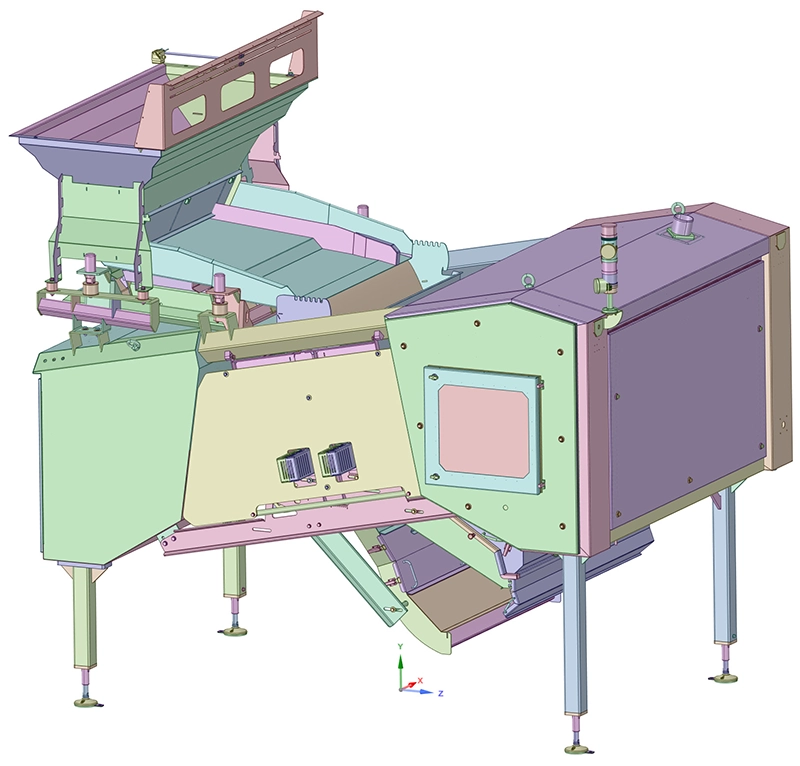
An international technology company required a seismic qualification of a large stainless steel sorting machine destined for a food processing plant in a seismically active region of Turkey. The goal was to determine whether an earthquake would cause structural failure of the machine — either as a whole or in part — potentially endangering personnel in the surrounding area.
Two areas of the machine were identified as particularly critical: the elevated funnel at the top of the structure, which is vulnerable due to its height and resulting lever arm, and the four supporting legs that carry the full 2,000 kg mass of the machine. The client provided site-specific ground floor response spectra (above the seismic isolator) for two orthogonal horizontal directions, requiring a thorough multi-directional seismic assessment.
Our Approach
We performed the seismic assessment using Finite Element Analysis in Ansys Mechanical, following the requirements of ASCE/SEI 7-16, ANSI/AISC 341-16 and ANSI/AISC 360-16. The analysis consisted of two sequential stages: a modal analysis followed by a Modal Response Spectrum Analysis (MRSA).
Model preparation and meshing
The 3D geometry was reduced to the structural elements that govern the machine's stiffness and strength, along with any components whose mass could cause damage if detached during a seismic event. All plate and hollow-profile elements were converted to midsurfaces and meshed with linear shell elements, resulting in a model of approximately 1,145,000 elements and 5.8 million degrees of freedom. Material density was adjusted to maintain the correct total mass of 2,000 kg, compensating for the non-structural parts that were excluded from the model.
Modal analysis
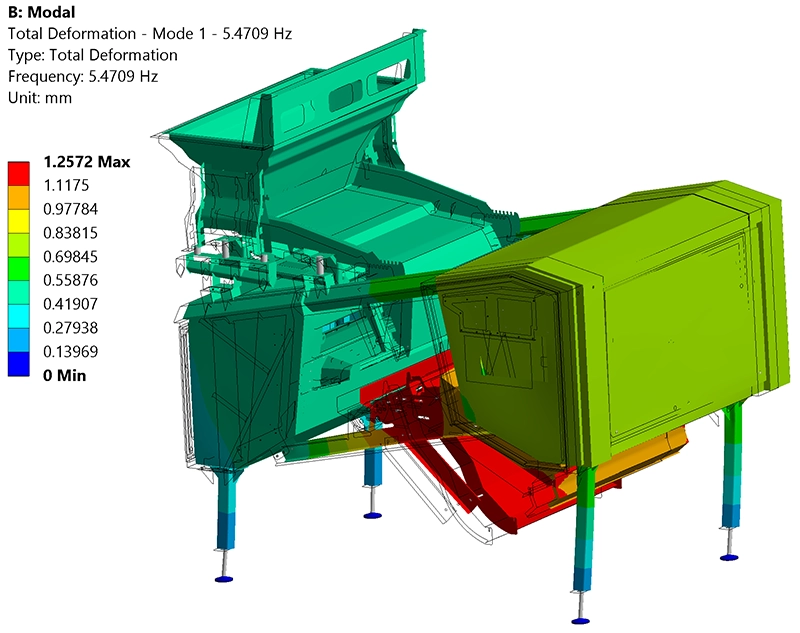
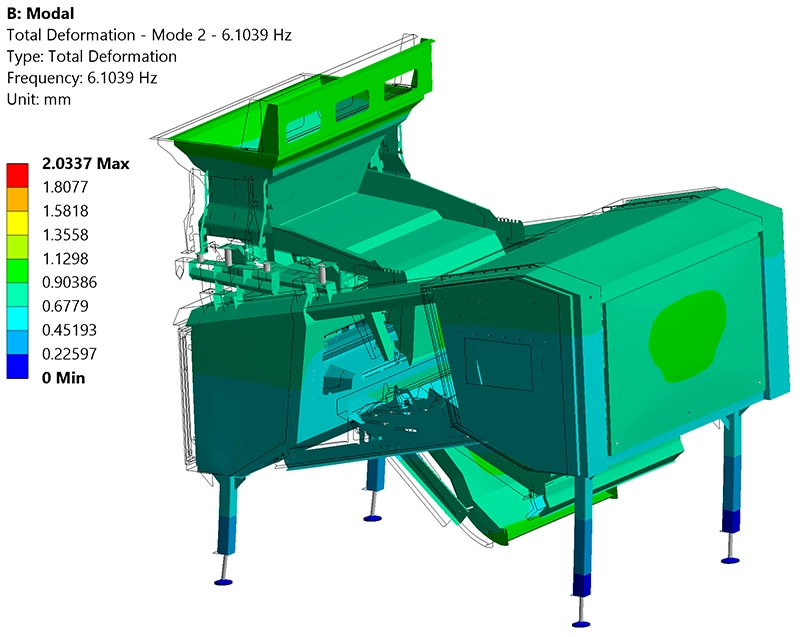
The first step was a modal analysis to extract the natural frequencies and mode shapes of the structure. We computed the first 20 modes, spanning a frequency range from 5.5 to 18.5 Hz. The combined modal mass participation in both horizontal directions exceeded 98%, well above the 90% minimum required by ASCE 7-16. Mode 1 at 5.5 Hz was dominant in the X direction and Mode 2 at 6.1 Hz in the Z direction.
Modal Response Spectrum Analysis
The modal results were then fed into the MRSA using the site-specific ground floor response spectra at 2% damping. To account for the fact that seismic excitation does not necessarily travel along a single axis, we evaluated 10 orthogonal combinations of the two horizontal spectra, ranging from single-axis loading (100% X or 100% Z) to combined loading scenarios (100% X + 30% Z, 30% X + 100% Z, and the most severe case at 100% X + 100% Z), each applied in two orientations (0° and 90°).
Results
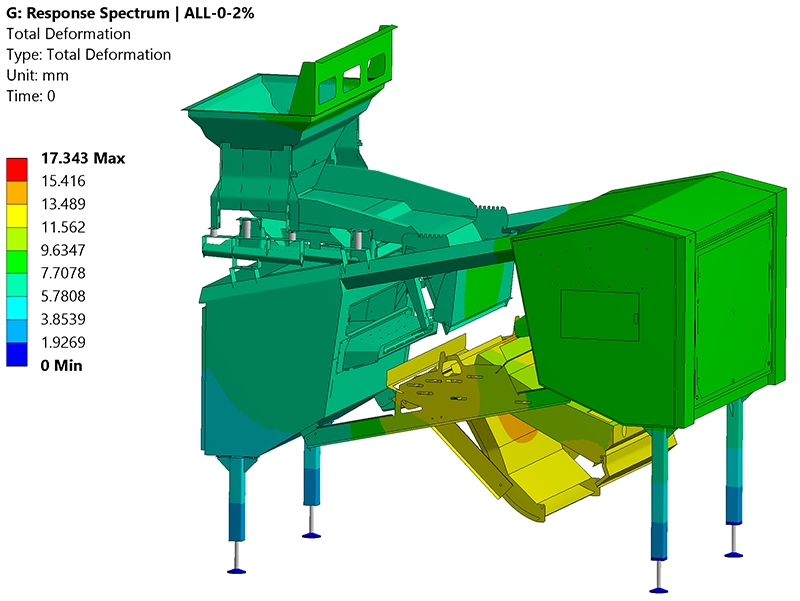
The most severe load combination was Combination 9 (100% X + 100% Z in the 0° direction), producing a maximum total deformation of 17.3 mm at the lower mid-section of the machine. These displacements were not excessive, which is consistent with the fact that the dominant natural frequencies (5.5 and 6.1 Hz) are separated from the spectral peak frequencies of the ground floor response spectra (around 2.7 Hz), resulting in a moderate dynamic amplification.
Globally, the Von Mises stresses remained well below the 200 MPa yield stress of the 1.4301 stainless steel across all 10 combinations. Localised stress concentrations exceeding yield were observed only at specific bolted connections and at the stiffeners of the supporting legs. The peak stresses at the bolted locations were identified as numerical singularities — artefacts inherent to the mesh discretisation rather than physically meaningful values. Furthermore, since MRSA is a linear analysis, any stress above yield is inherently conservative: in reality, localised plastic deformation would redistribute and reduce these peaks, and the energy absorption associated with yielding would further reduce the seismic response.
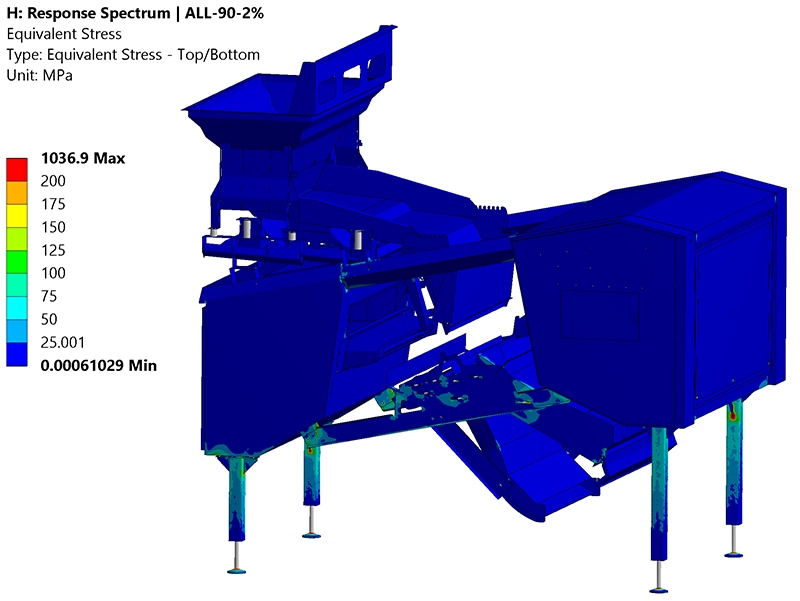
The funnel — the tallest and most exposed part of the machine — was found to undergo a maximum acceleration of approximately 1 g under the worst-case combination, which is sufficiently low to maintain structural integrity. The stresses in the funnel itself remained well within acceptable limits.
Value Delivered
By combining a modal analysis with a full Modal Response Spectrum Analysis across 10 orthogonal seismic load combinations, we delivered a comprehensive and code-compliant seismic qualification of the sorting machine. The results confirmed that the machine can withstand the site-specific seismic loads without catastrophic failure or danger to surrounding personnel.
The study provided the client with a detailed technical report including deformation, stress and acceleration results for every combination, a clear assessment of localised stress exceedances with engineering justification for their acceptability, visual iso-surface plots pinpointing the exact locations of elevated stresses, and the formal documentation needed for the facility's seismic safety approval process.
The analysis also gave the client confidence that no structural modifications to the machine were required for installation at the seismically active site, avoiding costly redesign and project delays.
Need a seismic or structural qualification for your equipment?
Whether you require a seismic analysis per ASCE 7, Eurocode 8 or another standard, a modal analysis to identify critical resonances, or a comprehensive strength assessment, we can support your project. Get in touch for a free initial consultation.
Contact us or call us at +32 478 618 118