The Challenge
A large industrial storage facility in the Netherlands needed to demonstrate that its mechanical ventilation system could adequately extract hazardous gas from the building interior. The facility stores materials that can release methane (CH4), and effective ventilation is critical: if methane concentrations build up in pockets or dead zones, the risk of reaching a hazardous level increases significantly.
The building has a volume of approximately 21,700 m3 with fresh air drawn in through three large openings at ground level and extracted through four roof-mounted ducts. The operator was evaluating two alternative extraction duct configurations and two flow rates, and needed objective, quantitative evidence to select the best option before committing to procurement and installation.
Our Approach
We modelled the full internal air volume of the building in Ansys Fluent, including the three ground-level intake openings, the four extraction ducts in each of the two proposed configurations, and all significant internal obstructions. A structured approach was followed across four scenarios.
Steady-state airflow analysis
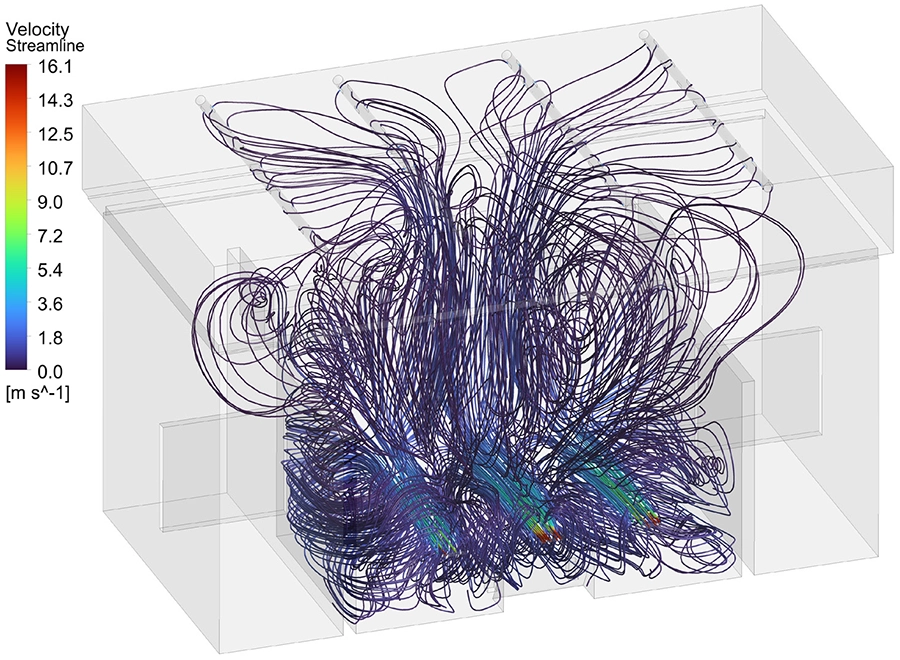
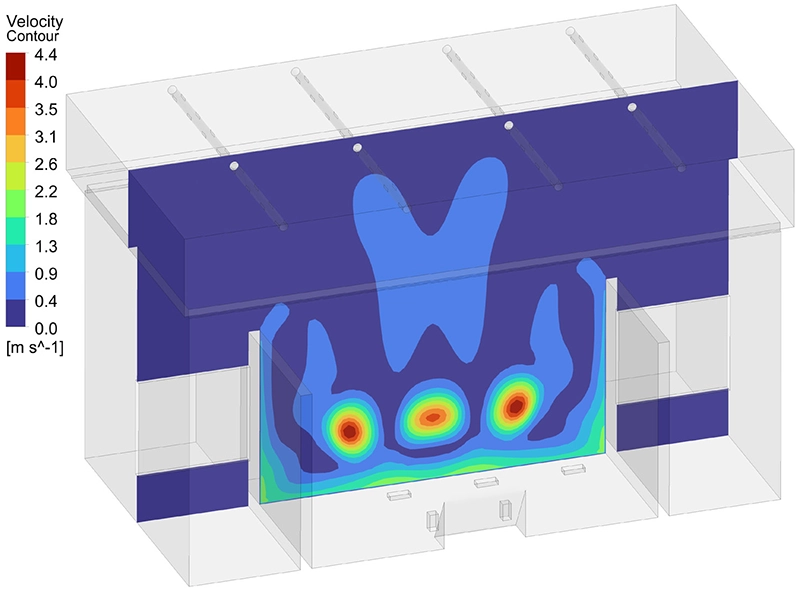
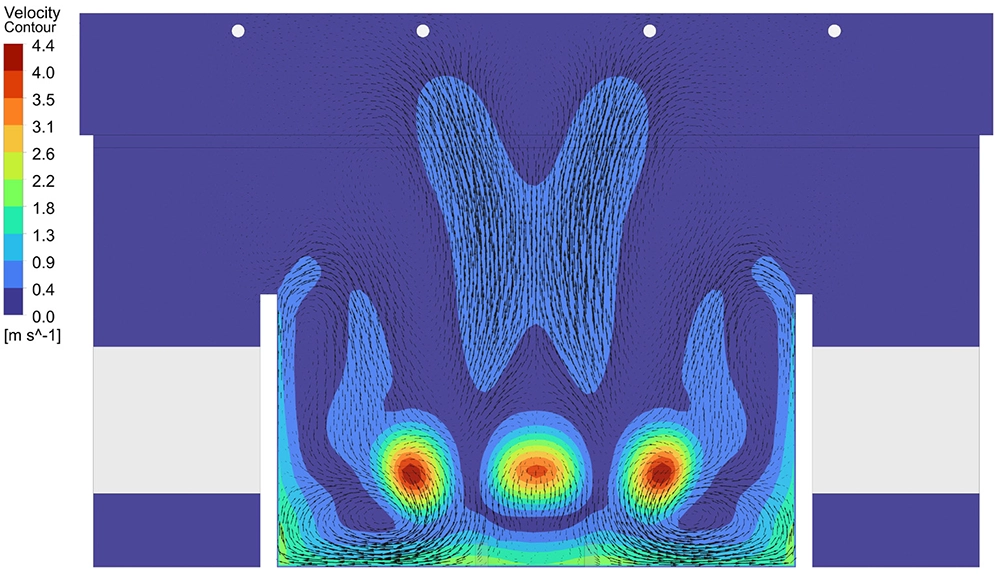
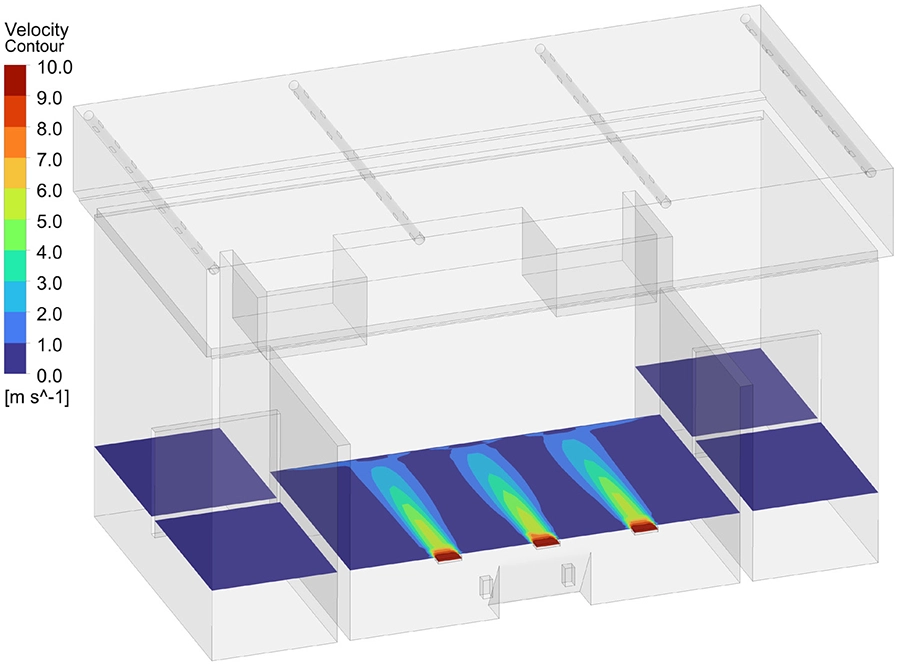
For each of the four combinations (2 duct layouts × 2 flow rates), we first solved the steady-state velocity field. Contour plots and velocity vector fields were extracted on three vertical cross-sections through the building as well as a horizontal section through the inlet openings. These results revealed the overall airflow pattern, jet trajectories, recirculation zones and stagnant areas.
Transient species transport
Starting from a uniform initial methane concentration of 5,000 ppm (0.5%), we ran a time-dependent species transport simulation for each scenario. The simulated time corresponded to one complete volume refresh: 1,735 seconds at 45,000 m3/h and 1,115 seconds at 70,000 m3/h.
Quantitative comparison
For each scenario we tracked the volume-averaged methane mass fraction over time and compared it against the ideal (linear) extraction curve. The deviation between the actual and ideal curves directly quantifies the ventilation inefficiency caused by dead zones.
Results
The steady-state analyses confirmed that both extraction layouts produce broadly similar flow patterns: strong upward jets from the three inlets, significant recirculation in the upper half of the building, and clearly identifiable stagnation zones in the corners and behind internal walls. The velocity contour plots showed that the second duct layout, with the extraction points spaced further apart, achieves slightly more uniform coverage across the roof area.
The transient species transport analyses provided the decisive insight. After one complete volume refresh, only approximately 60% of the initial methane had been extracted, far below the 100% that would occur in an idealised, perfectly mixed scenario. This significant deviation confirmed the presence of dead zones where gas lingers and is replaced very slowly.
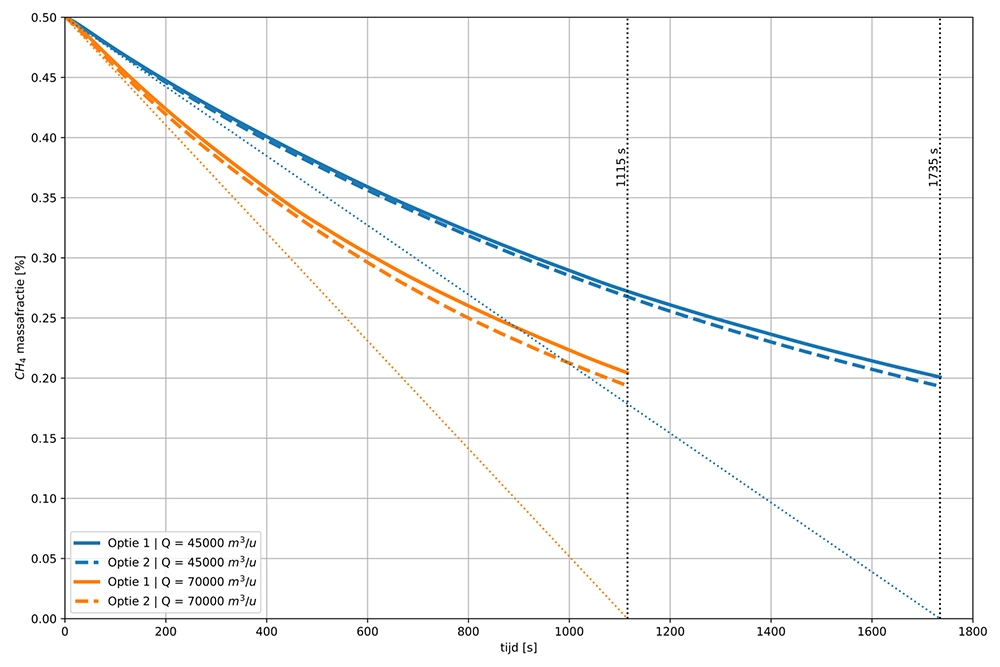
Comparing the two extraction layouts quantitatively, the second option extracted approximately 61% of the methane versus 60% for the first — a measurable but modest improvement. Increasing the flow rate from 45,000 m3/h to 70,000 m3/h accelerated the extraction process but did not substantially change the overall efficiency: the same proportion of gas was removed after one volume refresh, just in less time. Exponential extrapolation of the transient curves indicated that complete methane removal would require multiple volume refreshes regardless of the scenario chosen.
The results also provided animated transient visualisations showing how methane clears from the building over time — a powerful communication tool for safety reviews and stakeholder presentations.
Value Delivered
By combining CFD simulation with transient species transport modelling, we gave the operator a clear, visual and quantitative comparison of the four ventilation scenarios. Rather than relying on simplified air-change calculations, which assume perfect mixing and would have dramatically overestimated the system's gas clearance capability, the simulation revealed the true ventilation efficiency and pinpointed the locations where hazardous gas accumulates.
The study delivered an evidence-based selection of the preferred extraction duct configuration, a realistic prediction of the time required to reduce methane concentrations to safe levels, identification of critical stagnation zones for targeted design modifications, and the documentation required for the facility's safety assessment.
Facing a similar ventilation or flow challenge?
Whether you need to evaluate a ventilation system, optimise an extraction layout or simulate hazardous gas dispersion, we can help you in your projects. Get in touch for a free initial consultation.
Contact us or call us at +32 478 618 118