CFD Analysis
Fluid flow is complex, often counter-intuitive and notoriously difficult to predict from experience alone. Unexpected pressure drops, recirculation zones, poor mixing or uneven flow distribution can compromise product performance, reduce process efficiency and lead to costly redesign cycles. With Computational Fluid Dynamics (CFD) we give you a detailed, quantitative picture of what happens inside your system — so you can fix problems before they reach the prototype stage and optimise your designs with confidence.
Problems we solve with CFD
Our clients come to us when they need answers that measurements alone cannot provide — or when physical testing is too expensive, too slow or simply impossible at the design stage. Typical projects include:
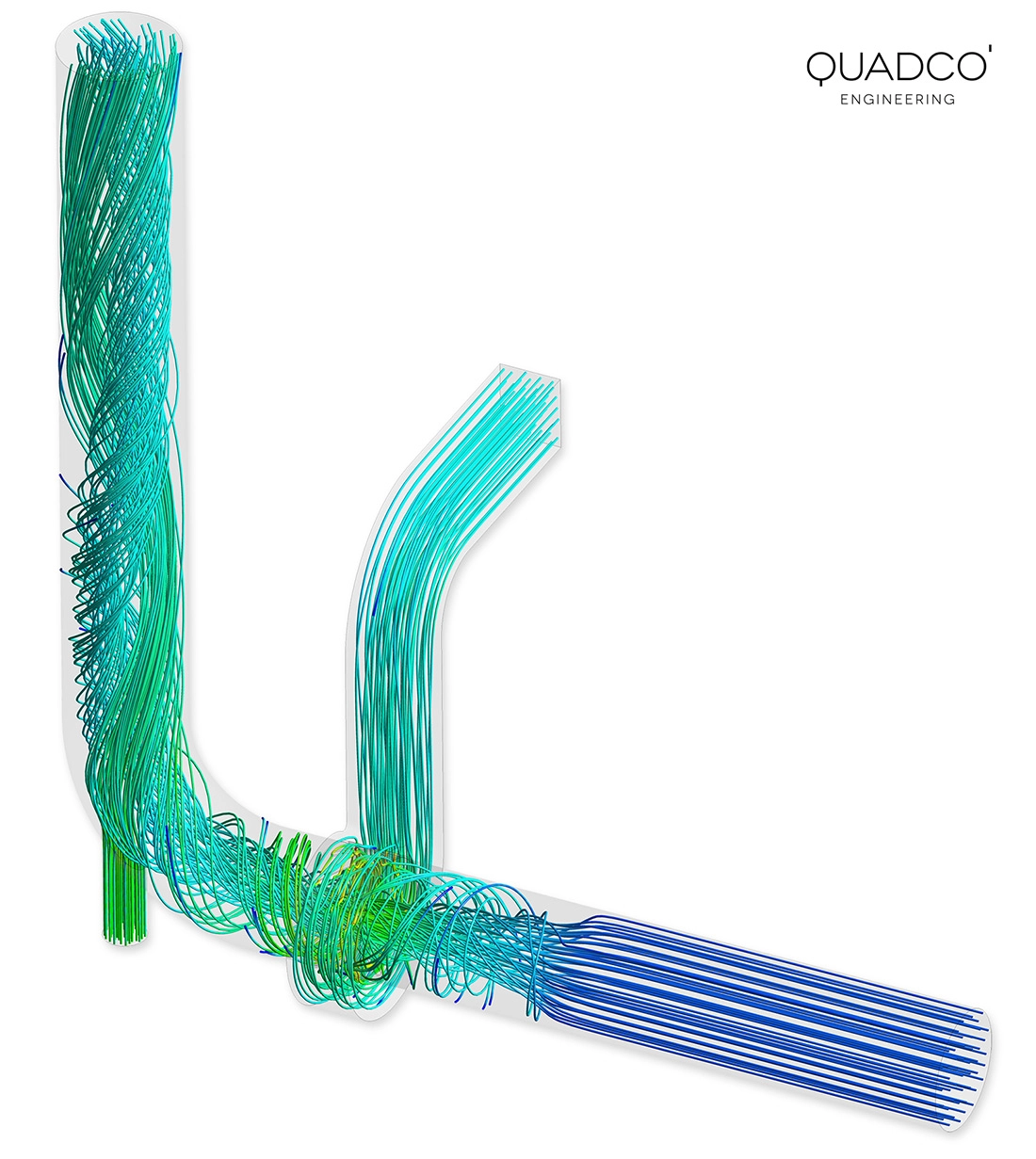
- Pressure drop and energy loss analysis — quantify losses through valves, pipes, manifolds or filter geometries and identify where improvements have the greatest impact.
- Flow distribution and uniformity — ensure even velocity or concentration profiles across heat exchangers, distribution headers, clean rooms or reaction chambers.
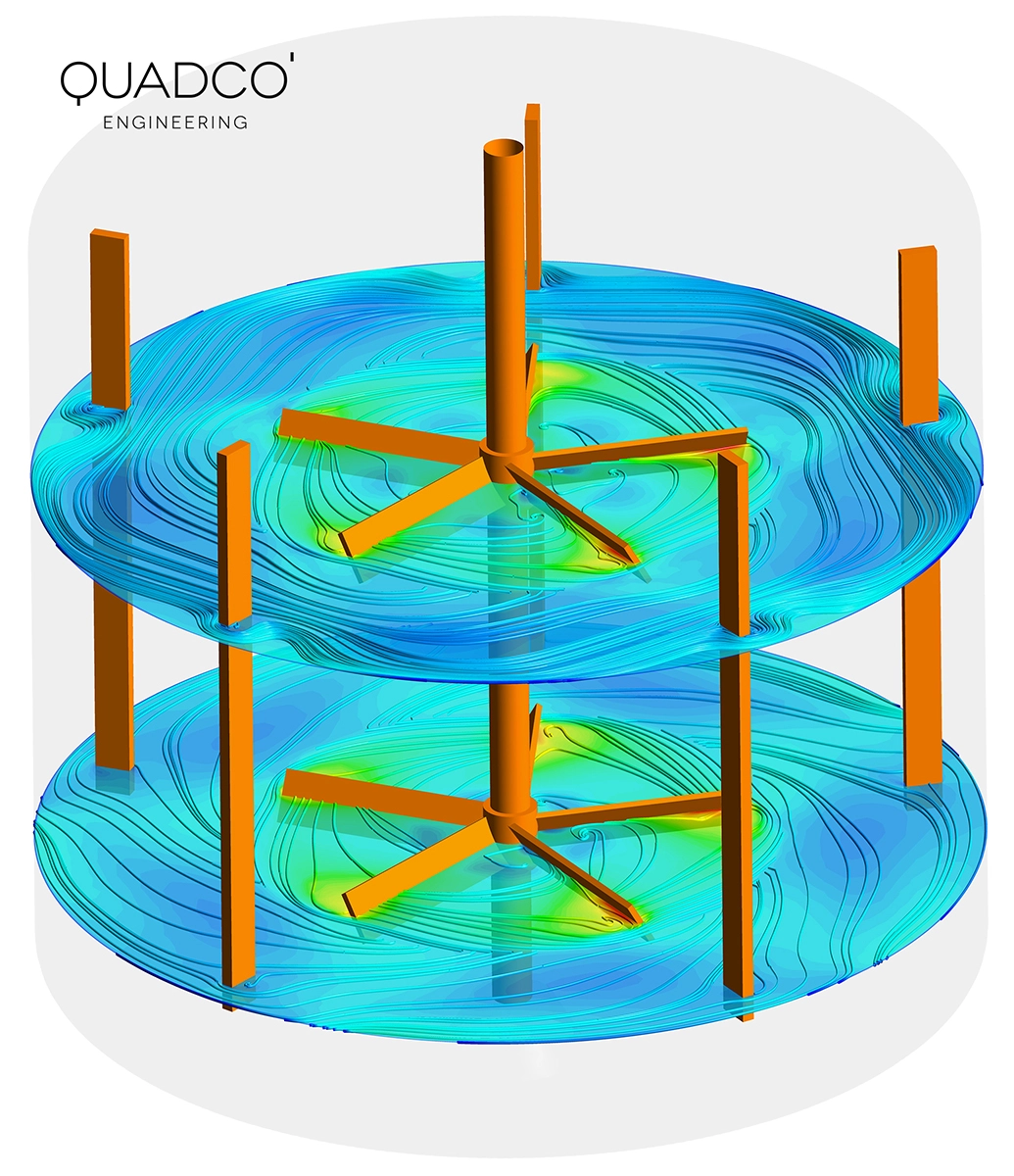
- Mixing and blending optimisation — evaluate impeller types, baffle configurations and injection strategies to achieve the desired mixing quality in less time.
- Turbomachinery performance — analyse and improve the efficiency of pumps, blowers, turbines and compressors by understanding the internal flow field in detail.
- Multiphase and free-surface flows — simulate gas-liquid interactions, sloshing, hydraulic jumps, cavitation and particle-laden flows.
- HVAC and ventilation design — verify air distribution, thermal comfort and contaminant extraction in buildings, clean rooms and industrial spaces.
- Process troubleshooting — investigate underperformance, unexpected erosion or vibration in existing installations and recommend targeted design changes.
What CFD reveals that testing cannot
A physical experiment can tell you the pressure at a few measurement points or the average temperature at an outlet. A CFD simulation gives you the complete velocity, pressure and temperature field at every location and every time step — including inside regions that are physically inaccessible to sensors.
This level of detail makes CFD uniquely powerful for understanding why a system behaves the way it does. Where does recirculation form? What causes the pressure spike? Why is the flow unevenly distributed? Once you understand the root cause, targeted design improvements become straightforward.
CFD also allows you to evaluate dozens of design variants at a fraction of the cost and time of prototype testing, making it the ideal tool for systematic optimisation and rapid what-if studies.
Types of flow we simulate
Our CFD capabilities cover the full spectrum of fluid flow phenomena. Whether your application involves slow, viscous flow through a narrow channel or high-speed compressible gas dynamics, we select the right modelling approach and turbulence model to deliver accurate, reliable results.
- Incompressible and compressible flow — from low-speed liquid systems to high-speed gas flows with shocks.
- Laminar, transitional and turbulent flow — using RANS, DES or LES turbulence models as appropriate for the application.
- Steady-state and transient simulations — capturing both time-averaged behaviour and time-dependent phenomena such as vortex shedding, pulsating flow or start-up transients.
- Multiphase flow — gas-liquid interfaces, free surfaces, particle transport, cavitation and boiling.
- Non-Newtonian fluids — for applications in the food, pharmaceutical and medical industry where fluid viscosity depends on shear rate.
- Rotating machinery — pumps, impellers, turbines, blowers and compressors using frozen-rotor, mixing-plane or sliding-mesh techniques.
- Reacting and species transport — combustion, chemical reactions, UV absorption and pollutant dispersion.
Industries and applications
We have delivered CFD projects across a wide range of sectors. Our experience ensures that we understand not just the simulation, but also the engineering context and the practical constraints of your industry:
- Process & chemical industry — mixers, reactors, separation equipment, galvanisation processes, filtration and catalysis.
- Water treatment — UV disinfection systems, hydraulic jumps, sedimentation tanks and aeration design.
- Energy & turbomachinery — pumps, valves, turbines, compressors and fuel supply systems.
- Building & HVAC — ventilation effectiveness, clean room airflow, thermal comfort assessment (PMV/PPD).
- Automotive & transport — aerodynamics, underhood airflow, fuel system analysis and cabin climate.
- Offshore & marine — wave loading, sloshing analysis, subsea flow assurance and caisson hydrodynamics.
- Medical & pharmaceutical — non-Newtonian blood flow modelling, drug delivery systems and sterile environment design.
Combined CFD and structural analysis
Fluid forces do not exist in isolation — they act on structures. When fluid pressures, thermal loads or flow-induced vibrations are important for the structural integrity of your design, we couple our CFD results with Finite Element Analysis through Fluid-Structure Interaction (FSI). For thermal problems that involve both fluid flow and solid conduction, see our dedicated heat transfer analysis services.
Have a fluid flow challenge? Let's talk.
Whether you need to troubleshoot an underperforming process, validate a new design concept or optimise flow distribution — our CFD specialists are ready to help you get the answers you need.
Get in touch for a free initial consultation. We will discuss your application, recommend the right simulation approach and provide you with a clear project proposal.
Contact us or call us at +32 478 618 118Want to learn about CFD yourself? Have a look at our Introduction to Computational Fluid Dynamics course.
Frequently asked questions
Common questions about CFD analysis and flow simulation services.