The Challenge
A specialist in refractory products required a structural verification of a free-standing steel stack prior to installation at an industrial site in Zwijndrecht, Belgium. The stack has a diameter of 0.8 m, stands 16 m tall and weighs 2,680 kg. It is constructed from Corten steel (equivalent to S355) and assembled from multiple flanged sections connected by prestressed M20 bolts, with M30 anchor bolts at the base plate.
The structure must withstand a demanding combination of forces: self-weight, wind loads according to EN 1991-1-4, seismic actions according to EN 1998-1, and the lifting forces that occur during crane installation in both horizontal and vertical orientations. The client needed a comprehensive Finite Element Analysis to verify the strength, stiffness and stability of the complete stack assembly under all these conditions, documented to Eurocode requirements.

Our Approach
The structural verification was performed in Ansys Mechanical using three solver types: static linear analysis, geometrically non-linear analysis (GMNA) for the buckling check, and a response spectrum analysis for the seismic assessment. All load cases and combinations follow EN 1990 (Basis of Structural Design), EN 1993-1-1 (General Rules for Steel Structures) and EN 1993-3-1 (Towers, Masts and Chimneys).
Meshing and material model
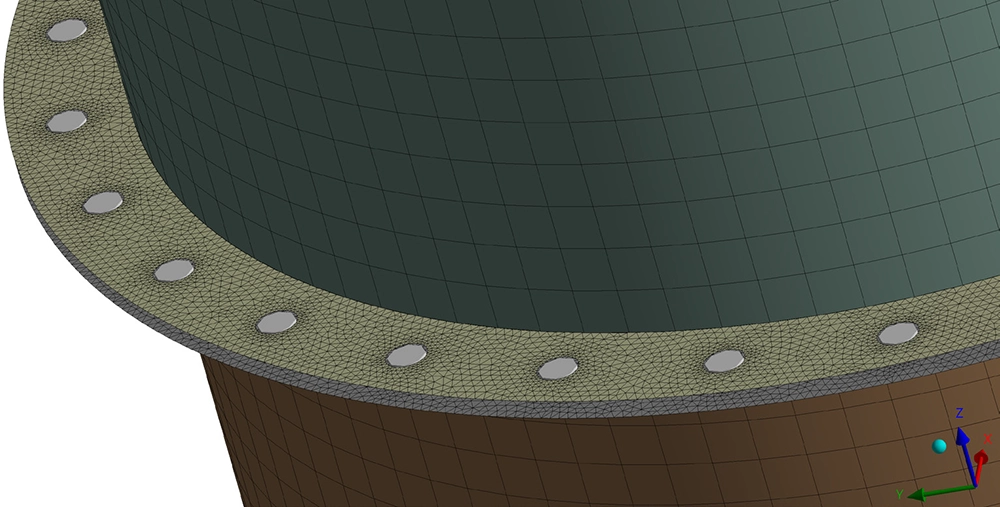
The complete stack geometry was meshed with quadratic shell elements, well-suited for the thin-walled cylindrical sections. The mesh was refined at the bolted flanges to accurately capture the stress concentrations introduced by the prestressed bolt connections. The material model uses the properties of S355 steel: a Young's modulus of 210,000 MPa, a yield strength of 355 MPa and a density of 8,750 kg/m3. The maximum allowable stress per Eurocode is 355 MPa / 1.15 = 309 MPa.
Wind load calculation
The wind loading was determined in accordance with EN 1991-1-4 for Terrain Category II at the Zwijndrecht site location. The basic wind velocity is 25 m/s, producing a peak wind pressure of 1.039 kN/m2 at the 16 m reference height. After applying the structural factor, Reynolds number corrections and end-effect factor for the cylindrical geometry, the total characteristic wind force on the stack amounts to 10.8 kN. Two non-simultaneous wind directions were assessed: one along the primary axis and one at 45° to check the effect of asymmetric loading on the bolted flanges.
Seismic analysis
A response spectrum analysis was performed according to EN 1998-1, with simultaneous horizontal and vertical elastic response spectra. The seismic parameters correspond to Seismic Zone 1 on Ground Type E, with an importance factor of 1.2 applicable to industrial chimney structures.
Lifting analysis
Two crane lifting conditions were evaluated: the stack suspended horizontally (as it would be transported from the fabrication area) and vertically (during final erection). In both cases, the constraints were applied at the lifting tube attachments, and the self-weight was factored with a ULS safety factor of 1.35.
Load combinations
A total of eight load combinations were assessed: three at the Serviceability Limit State (SLS) for the stiffness check, three at the Ultimate Limit State (ULS) for the operational strength check, and two ULS combinations for the lifting conditions. The seismic load case was evaluated separately, as prescribed by Eurocode.
Results
Strength verification — operational loads
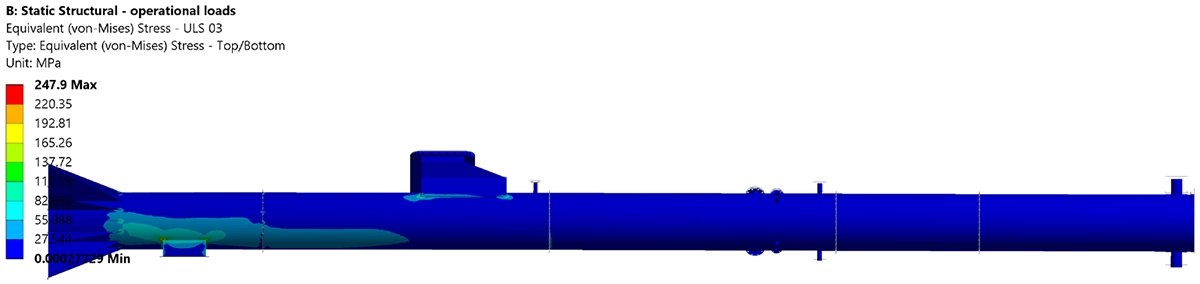
The governing operational load combination is ULS 02 (self-weight + wind in the primary direction), which produces a maximum Von Mises equivalent stress of 258 MPa. This is 17% below the allowable limit of 309 MPa. Under self-weight alone (ULS 01), the maximum stress is just 37 MPa, confirming that wind loading is the dominant action on this tall, slender structure.
Stiffness verification — operational loads
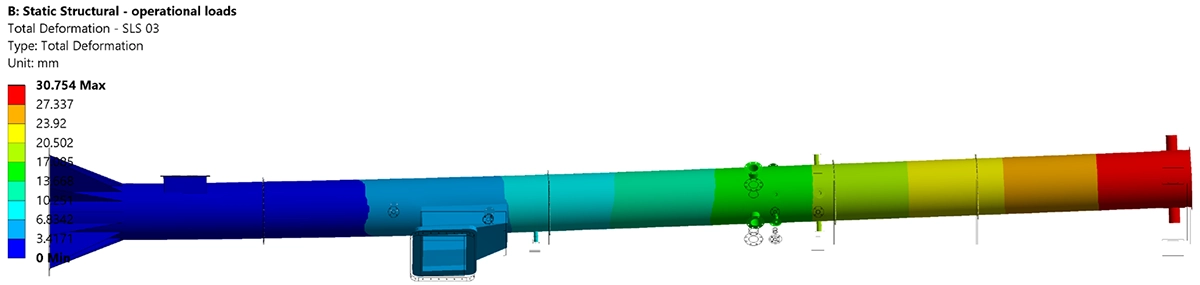
The maximum allowable deflection was set at L/250 = 64 mm, in line with Eurocode requirements for chimney structures. Under the most demanding wind combination (SLS 02), the maximum tip displacement is 38 mm, corresponding to a deflection ratio of L/421 — well within the acceptable range.
Lifting loads
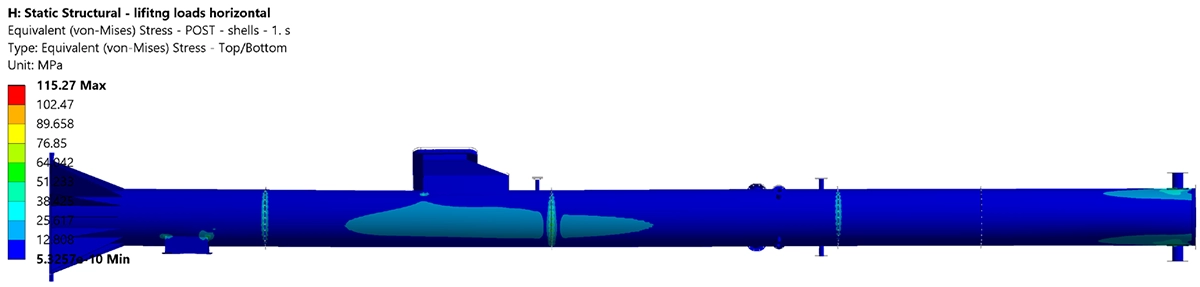
The most demanding lifting condition is the horizontal position (ULS 04), where the stack hangs from its lifting tubes with gravity acting perpendicular to the longitudinal axis. The maximum equivalent stress in this configuration is 115 MPa, with a peak deflection of 5.8 mm. In the vertical lifting position (ULS 05), stresses reduce to just 24 MPa and deflections to 1.4 mm. Both conditions are well within the structural limits.
Seismic assessment
The response spectrum analysis yielded a maximum equivalent stress of 40 MPa and a maximum deformation of 8 mm under the combined horizontal and vertical seismic actions. These values are far below both the strength and stiffness limits, confirming that the seismic loads at this Belgian site are not governing for the stack design.
Buckling stability
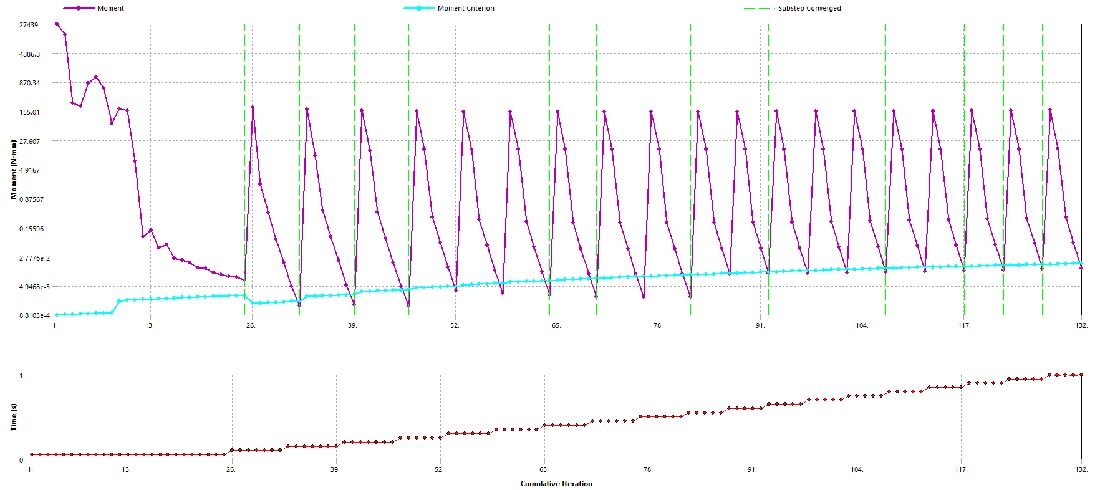
A GMNA buckling analysis was performed for the most severe load combination (ULS 03) using the Newton-Raphson iteration method. The analysis applied five times the characteristic wind load (54 kN) in 20 incremental load steps. All steps converged successfully, demonstrating that no buckling instability occurs even at load levels far exceeding the design wind forces.
Value Delivered
The analysis confirmed that the stack design satisfies all Eurocode requirements for strength, stiffness and stability. The maximum operational stress of 258 MPa under wind loading leaves a 17% margin below the allowable limit, the tip deflection of 38 mm is well within the L/250 criterion, and the GMNA buckling analysis demonstrated structural stability at five times the design wind load.
By combining static, non-linear and dynamic analysis methods in a single FEA study, we gave the client a complete structural assessment covering every phase of the stack's life cycle — from crane lifting during installation to long-term operational exposure to wind and seismic actions. The detailed technical report, including deformation and stress contour plots for every load combination, provided all the documentation needed for Eurocode compliance and third-party review.
This project illustrates how simulation-driven structural verification provides far greater insight than simplified hand calculations, particularly for slender structures where the interaction between wind loading, bolt preload and non-linear buckling behaviour governs the design.
Need a structural analysis for your stack, chimney or steel structure?
Whether you require a Eurocode-compliant strength verification, a wind or seismic load assessment, a non-linear buckling analysis, or a lifting check for your installation procedure, we can help. Get in touch for a free initial consultation.
Contact us or call us at +32 478 618 118