The Challenge
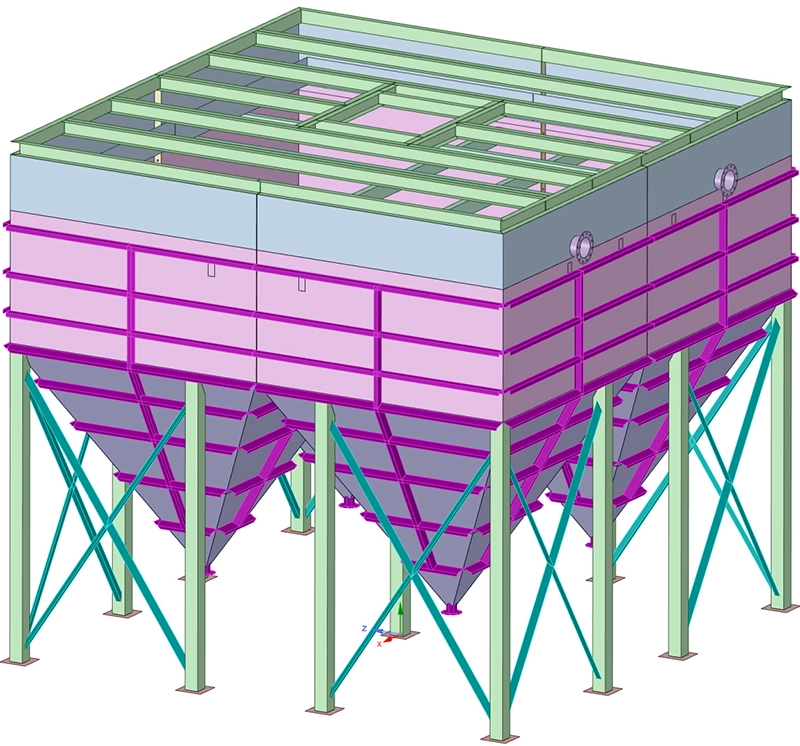
A steel construction company required an independent structural verification of a large stainless steel water tank destined for a food processing facility in the Netherlands. The tank features a distinctive design: four square hoppers connected via bolted flanges, supported by twelve outer columns and one central column. It serves a dual purpose — storing process water in the upper section and collecting sludge sediment in the lower hoppers.
The question was straightforward but critical: does the tank design meet the strength and stiffness requirements of the applicable Eurocode standards under all realistic operating and environmental load conditions? A comprehensive Finite Element Analysis was needed to answer it with confidence.
Our Approach
The structural verification was performed using a static-linear FEA in Ansys Mechanical, following the requirements of EN 1990 (Basis of Structural Design), EN 1991-1 (Actions on Structures) and EN 1993-4-2 (Design of Steel Tanks). The analysis covered both stiffness (Serviceability Limit State) and strength (Ultimate Limit State) checks.
Model preparation and meshing
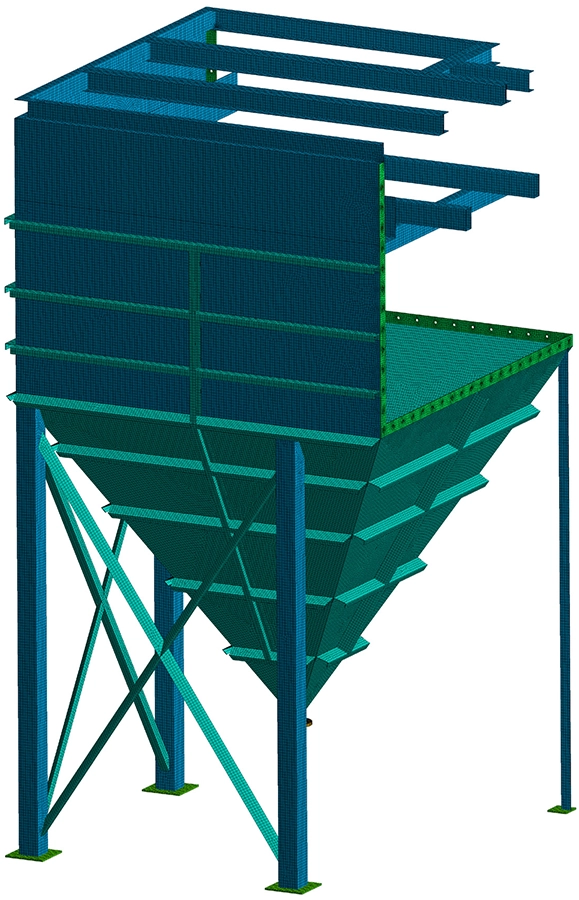
Since both the geometry and the loading conditions are symmetrical about two vertical planes, we exploited double symmetry and modelled only one quarter of the full tank. This significantly reduced computation time without sacrificing accuracy. The entire structure was meshed with 2D shell elements — ideally suited for the thin-walled plates and folded profiles that make up the tank body, hoppers and platform.
Material assignment
The tank plates (rectangular section and hoppers) are manufactured from stainless steel S316, with a yield strength of 240 MPa. All other structural components — the support columns, bracing, platform structure and reinforcement profiles — are stainless steel S304, with a yield strength of 215 MPa. Both materials have an elastic modulus of 193,000 MPa.
Load cases and combinations
Six individual load cases were defined to capture all operational and environmental forces acting on the structure:
- Self-weight — gravitational acceleration applied to the tank structure, including four cyclone separators (100 kg each) modelled as point masses
- Hydrostatic pressure (water) — water at 1,000 kg/m3 from the inlet at the top down to one metre above the discharge opening
- Hydrostatic pressure (sludge) — sludge at 1,700 kg/m3 filling the lower hopper section
- Platform live load — a characteristic load of 200 kg/m2 on the grating of the access platform
- Wind — a characteristic wind pressure of 1.125 kPa on the tank walls and profiles
- Snow — a characteristic snow load of 0.45 kN/m2 on the platform surface
These load cases were combined into 3 Serviceability Limit State (SLS) combinations for the stiffness check and 8 Ultimate Limit State (ULS) combinations for the strength check, each with the appropriate partial safety factors prescribed by Eurocode.
Results
Stiffness verification (Serviceability Limit State)
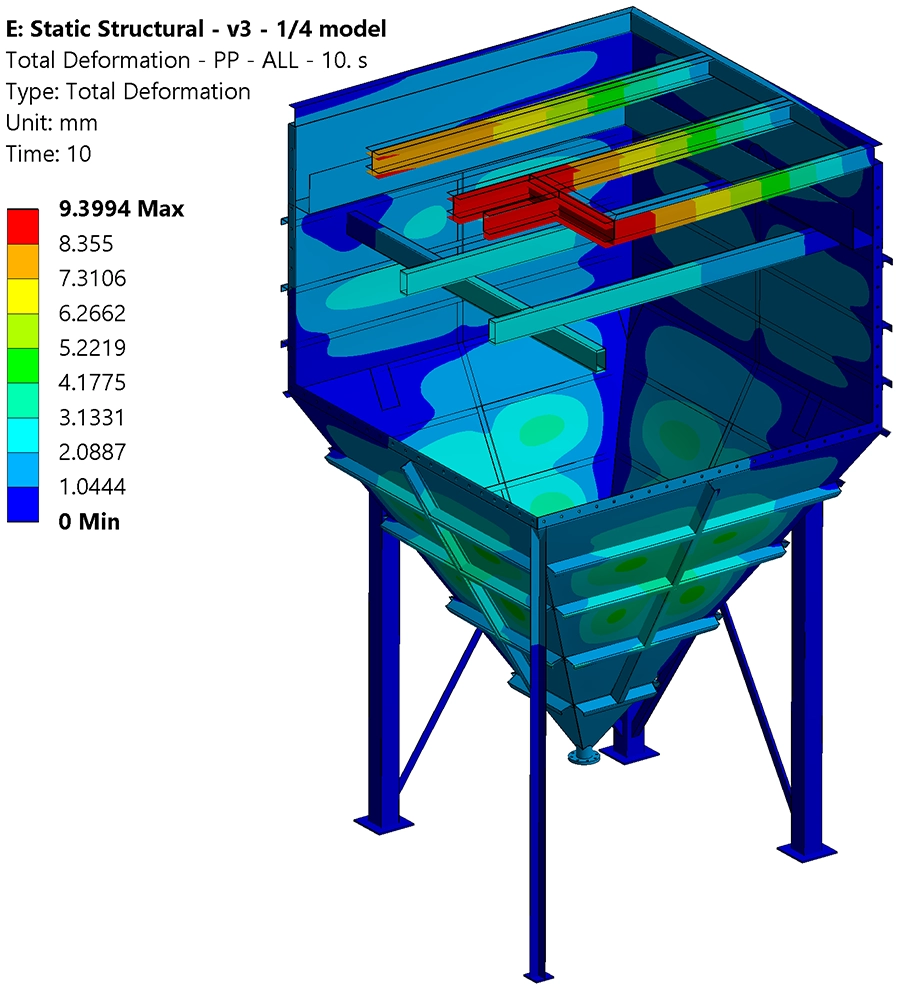
The maximum deformation across all three SLS combinations was 10.9 mm, occurring in the 5.75 m long folded profile of the access platform under the combination with full platform live load. The deflection-to-span ratio of 1/523 is well below the Eurocode limit of 1/250 for platforms, confirming that the structure is sufficiently stiff for normal operation.
Strength verification (Ultimate Limit State)
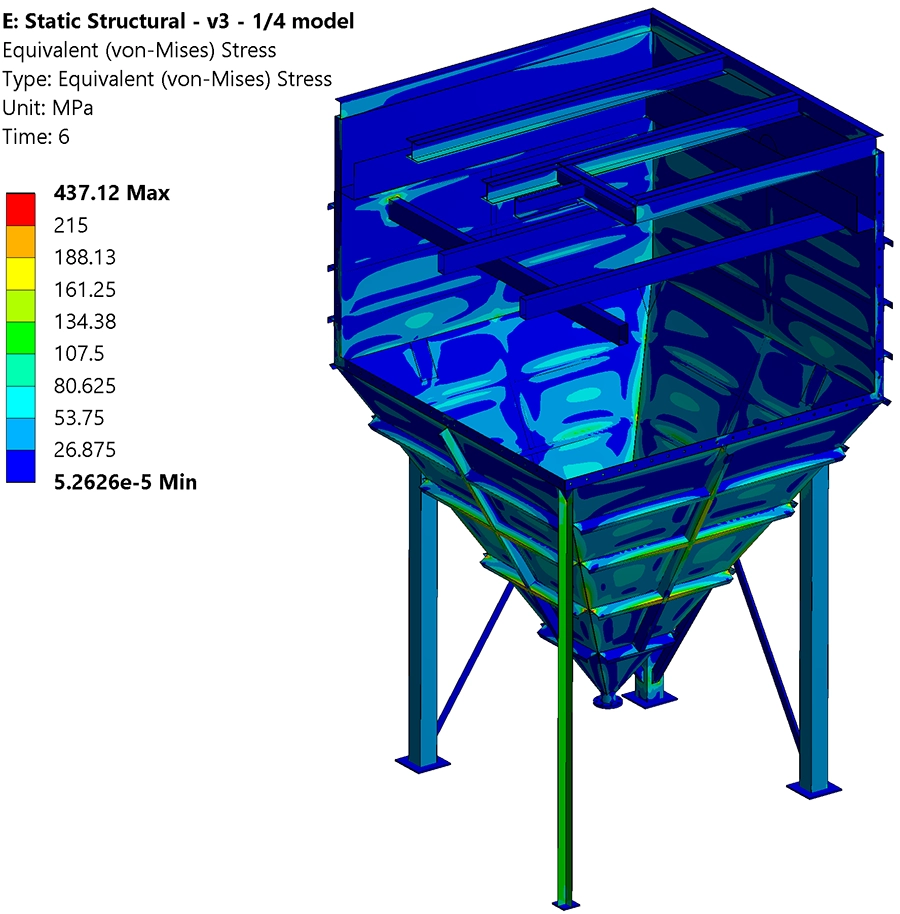
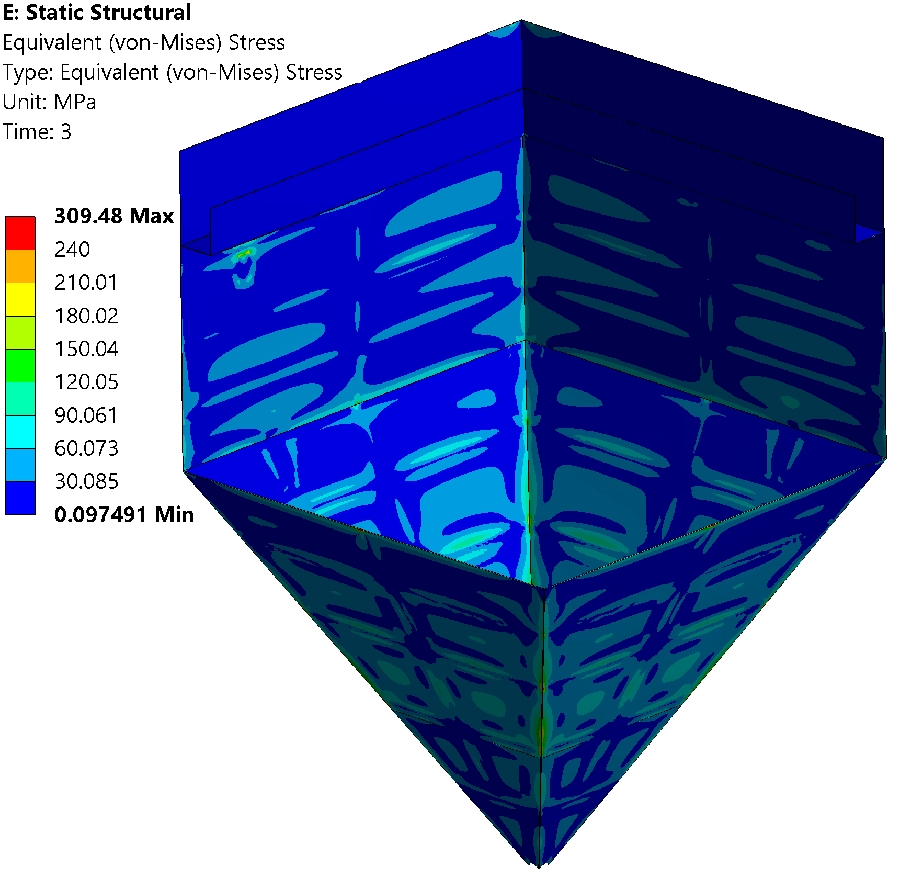
The Von Mises equivalent stresses were evaluated across all 8 ULS combinations for each structural component group: the tank plates, the reinforcement profiles and the access platform. In all cases, the stresses remained below the allowable limits: 215 MPa for the S304 components and 240 MPa for the S316 tank plates.
Some localised stress concentrations exceeding the allowable values were identified at sharp geometric transitions. These were assessed as numerical singularities — artefacts inherent to the FEA mesh discretisation at re-entrant corners and abrupt section changes. They do not represent physically meaningful stress states and would not occur in the actual welded structure, where fillet radii and weld material provide a smooth load transfer.
Value Delivered
The FEA provided a complete and Eurocode-compliant structural verification of the water tank design, covering both stiffness and strength under all relevant load scenarios. By exploiting double symmetry and using shell elements tailored to the thin-walled construction, we delivered accurate results within a short project timeline.
The analysis confirmed that the tank design satisfies the requirements of EN 1990, EN 1991-1 and EN 1993-4-2 without the need for design modifications. The client received a comprehensive technical report with deformation and stress contour plots for every load combination, a clear assessment of localised stress peaks with engineering justification, and all the formal documentation needed for third-party approval of the tank construction.
This project demonstrates how a well-executed Finite Element Analysis can provide the quantitative confidence needed to approve a complex structural design — replacing conservative hand calculations with a detailed, transparent assessment that captures the true load distribution through the entire structure.
Need a structural verification for your tank, vessel or steel structure?
Whether you require a Eurocode-compliant strength assessment, a stiffness verification under complex load combinations, or a full FEA of a pressure vessel, tank or supporting structure, we can help. Get in touch for a free initial consultation.
Contact us or call us at +32 478 618 118